3D Printing and Education - ROSA3D and AGH Solar Plane
In 2017, several students from the AGH University of Krakow decided to build a solar-powered aircraft. Today, the AGH Solar Plane Student Research Group operates at the Faculty of Energy and Fuels and consists of nearly 80 students divided into several sections: construction, electronics, programming and marketing. Their projects are just as diverse – from unmanned solar-powered aircraft and VTOLs to specialised algorithms designed for specific competitions. There is one thing that connects all these projects – 3D printing technology. Today, a significant part of their structures comes directly from a 3D printer, made using ROSA3D filaments.
The VITOLD Project – an aircraft straight from a 3D printer
A VTOL (Vertical Take-Off and Landing) unmanned aircraft combines the advantages of multirotors and fixed-wing aircraft – it takes off and lands vertically, while behaving like a conventional fixed-wing aircraft during horizontal flight. In theory, this is an ideal combination. In practice, however, it also means facing the challenges associated with both types of aircraft at the same time. After many hours of design work and analysis, the decision was made to produce most of the project using 3D printing technology. This choice addresses several issues at once: it enables rapid iteration, the production of complex geometries and the adaptation of each component to a specific function. However, the main challenge when building aircraft is always the same – keeping the weight as low as possible while maintaining adequate strength and rigidity. This is precisely where the choice of filament becomes crucial.
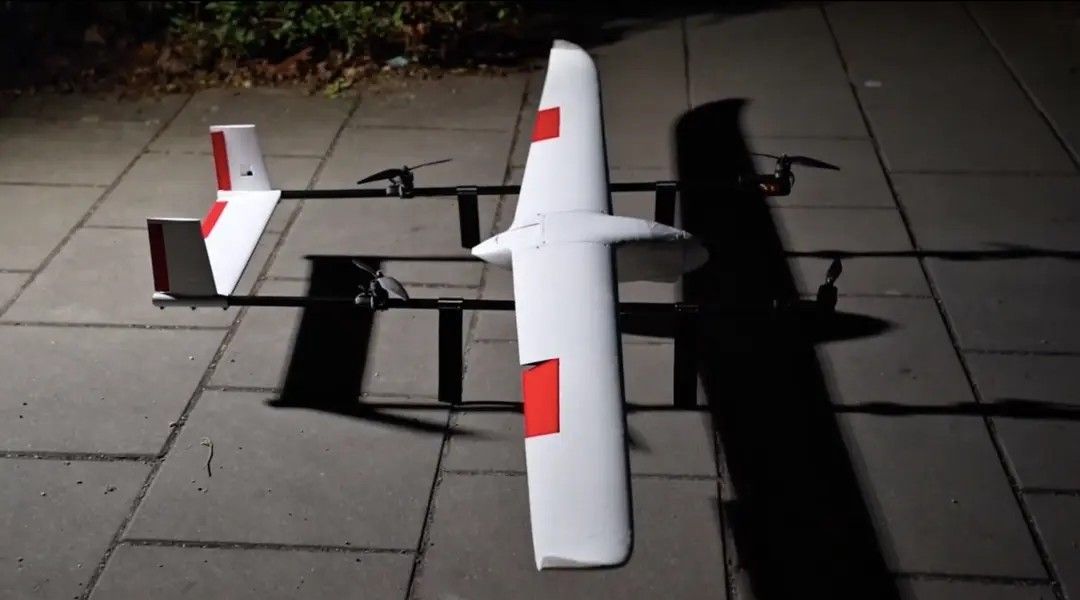
Wings and fuselage made of ASA+10CF
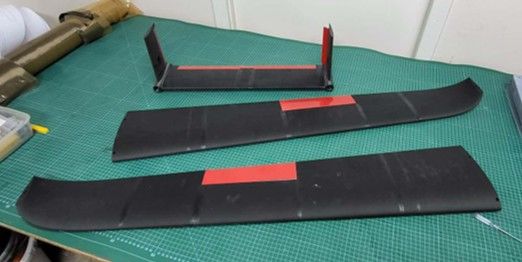
The first test wings were printed using PETG-10CF . Although the material was strong, it unfortunately proved to be too heavy. A different filament was needed. After extensive testing, the final version of the wings, stabiliser and fuselage was produced using ASA+10CF . The ten-percent carbon fibre content gives this filament a tensile modulus of elasticity of 2870 MPa and very high dimensional stability. The ASA base, in turn, provides resistance to UV radiation and weather conditions, which is particularly important for structures operating outdoors. This combination of properties made it possible to significantly reduce the weight of the structure: the wings were printed with a single perimeter and only 3-percent gyroid infill. To maintain the required rigidity with such a small amount of material, the wings were additionally laminated with a single layer of fibreglass – a simple and cost-effective reinforcement method that works extremely well in practice when combined with 3D-printed parts.
Joining components – what should you use to bond 3D prints?
Building 2.4-metre-span wings from ASA+10CF using 3D printing is not only a matter of selecting the right filament, but also of creating durable joints between individual components. To determine the best approach, the team conducted its own tests. The bond between the wing segments does not have to carry all the loads on its own. The required rigidity and bending resistance are provided by spars made from carbon fibre tubes. The chemical bond holds the printed segments together, while the spars absorb the loads.
Three methods were tested: pure acetone, mixtures of acetone and ASA filament in different proportions, and two-component epoxy adhesive. The following conclusions were drawn from the tests:
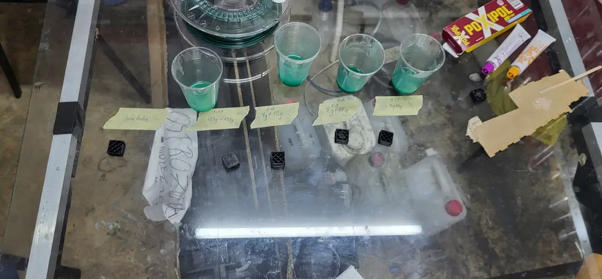
● Pure acetone works quickly, but the working time is so short that precisely aligning larger components was almost impossible.
● Epoxy adhesive performed surprisingly poorly – the joint proved to be more brittle and less resistant to tensile loads than expected.
● The best results were achieved using mixtures of ASA and acetone, particularly in proportions of 2:18 and 3:17. The higher viscosity of the thicker mixture extends the working time, allowing the adhesive to wet the surface effectively and bond evenly. The tensile strength of all ASA-and-acetone variants was rated 9/10 – even higher than that of the epoxy adhesive.
Motor and tube mounts – PETG-10CF
A lightweight structure is not suitable for every application. The motor mounts and load-bearing tube mounts are subjected to dynamic loads during vertical take-off, which means that impact strength is more important in this case than minimising weight. These components were produced using PETG-10CF from ROSA3D FILAMENTS – a material that was too heavy for the wings but performs exceptionally well when used for mounts. Its impact strength of 45 kJ/m² and good layer adhesion make it an ideal choice for such applications.
Vibrations – TPU 96A
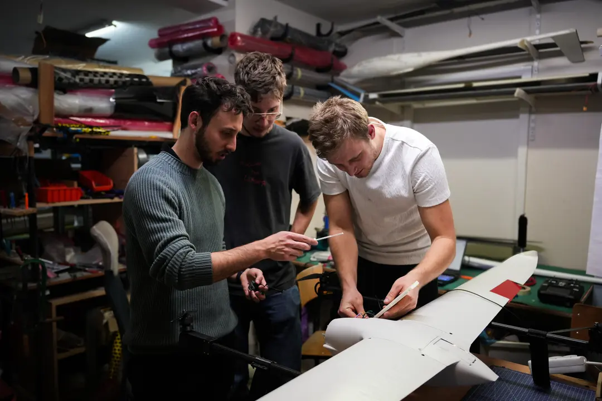
Operating motors generate vibrations which, if not dampened, spread throughout the structure and can eventually damage the onboard electronics. The solution to this problem was to use flexible spacers made from TPU 96A between the load-bearing tube and the motor mount. With a tear strength of 140 kN/m and an elongation at break of 350%, the material absorbs vibrations before they reach components that need to be protected.
Motor tilt mechanism – PA12+15CF
The transition of a VTOL aircraft from vertical to horizontal flight requires a mechanism that tilts the motors. This component must operate under constant dynamic loads and transfer the torque generated by the propellers. No deformation or play can be allowed.
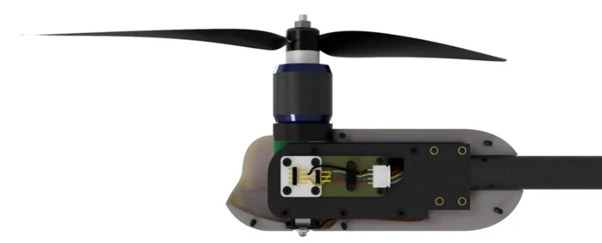
PA12+15CF – a polyamide with a 15-percent carbon fibre content – was selected for the mechanism. Its modulus of elasticity is 7995 MPa, while its tensile strength at break is 123 MPa. For comparison, this is almost three times more than that of popular ABS. The printed component behaves like a part made from a lightweight aluminium alloy, while taking significantly less time to print than to machine and being easier to prototype.
The rest of the aircraft and everyday workshop activities
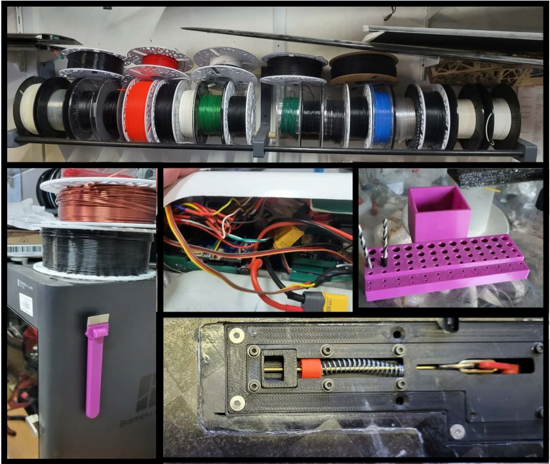
In addition to the main structures, 3D printing is also used to produce smaller yet equally important components: electronics housings, mounts, adapters, guides and release mechanisms. ASA, ABS and PETG are most commonly used for these applications – proven materials that offer design flexibility and perform well outdoors.
Before printing a final component using the target filament, it is usually prototyped using a material such as PLA Starter . A cheaper material, a faster print and the same geometry – this is enough to verify whether the design is correct and whether it needs to be refined before the final print. This also makes it possible to test all the components and introduce any necessary improvements.
One more category of applications is worth mentioning, even though it is rarely discussed in the context of aviation projects: tools. Printer scrapers, profiled holders for securing carbon tubes in a vice, containers for milling cutters and drill bits, and filament shelves. They may not sound particularly spectacular, but without them, the larger projects and structures could not be created.
Summary
Each project developed by the student group involves multiple layers of decisions and materials. AGH Solar Plane uses a variety of filaments – ASA+10CF for the wings, PETG-10CF for the mounts, TPU 96A near the motors, PA12+15CF for the tilt mechanism, and many others – depending on the requirements of each individual component. 3D printing is a technology that works equally well in aviation, robotics, medicine and student workshops. However, the key is not the technology itself, but the conscious selection of materials. The extensive range of ROSA3D FILAMENTS products ensures that every student research group can find an answer to its specific design requirements, whether the application involves a wing, a motor mount or vibration damping.

ROSA PLAST SP. z o.o.
ul. Hipolitowska 102B
05-074 Hipolitów, POLAND

Email
eshop@rosa3d.pl
Our team is at your disposal on working days during the hours:
od 7:00 do 15:00
Follow us