Using 3D Printing in Education – ROSA3D and PUT Rocketlab
The PUT Rocketlab, founded in 2017 on the initiative of Aerospace Engineering students, now brings together around 100 students from various faculties and universities in Poznań. The team carries out its projects under the supervision of researchers from the Institute of Thermal Engineering. The group designs, builds, and tests supersonic sounding rockets, develops hybrid and liquid propulsion technologies, conducts research, and actively participates in competitions, trade fairs, and scientific conferences. Over the past few years, with the support of our ROSA3D brand, PUT Rocketlab has successfully completed numerous innovative projects.
Student research clubs at Polish universities are now among the most dynamic laboratories of young talent and the clearest proof that Polish technical thought does not end in the lecture hall. It is there that students take responsibility for real projects and learn how to work effectively as a team. Increasingly, the secret weapon of these clubs is 3D printing — enabling them to move from a CAD model to a working prototype within just a few hours, tailor components to specific electronics, reduce the weight of structures, and quickly implement improvements after testing. Thanks to such tools, student research clubs can complete projects much faster and share their achievements with the wider scientific community.
The Hopper project and PLA LW AERO
The Hopper project was created as a test platform that enables the design and testing of new control algorithms and propulsion systems without the need to build costly full-scale rockets. During each so-called “hop test,” the vehicle launches vertically, climbs to an altitude of several to a dozen meters, performs a programmed hover or tilt maneuver, and then returns to the landing pad using precise landing in a closed-loop thrust control mode. This approach allows multiple flights to be carried out in a single day, with hardware recovery and immediate telemetry analysis after each attempt, significantly shortening the engineering iteration cycle.
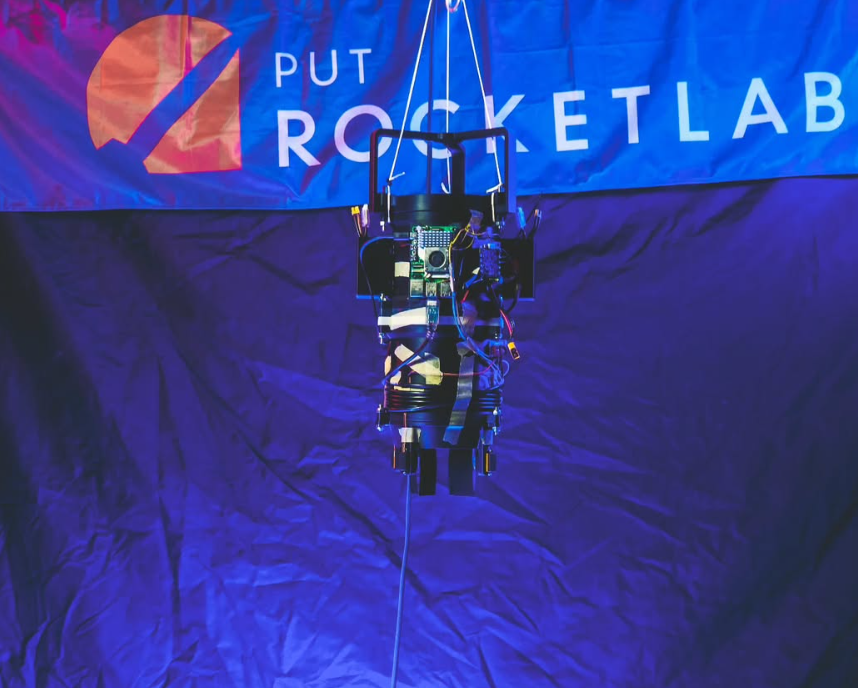
Until now, the primary fuselage structure and avionics enclosures have been 3D printed from PET-G and its carbon-fiber–reinforced variant, (PET-G + 10CF). The combination of high impact resistance, elevated thermal resistance, and a reliable, predictable printing process has made this material an excellent choice for the first versions of the Hopper.
In the latest phase of the project, the focus has shifted from structural strength to minimizing overall weight, which will allow for longer engine operation and a higher achievable altitude. For this reason, the next series of fuselages will be printed from PLA LW AERO a filament that, thanks to controlled expansion during printing, can reduce the density of the outer shell by 30–40% while maintaining comparable stiffness.
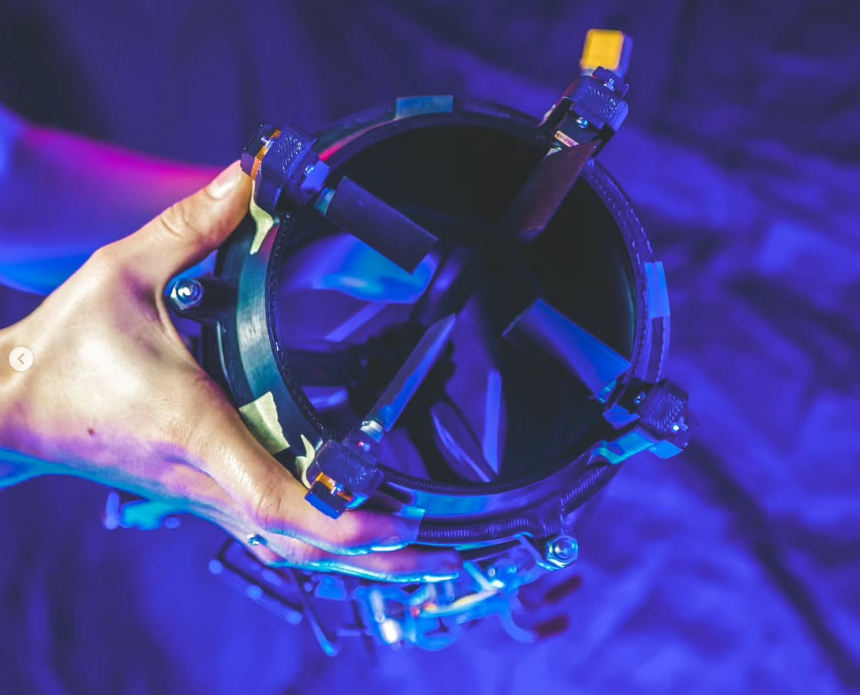
Every gram saved translates into several additional seconds of thrust, a longer flight, and a richer set of sensor data. Lower mass also means reduced inertia, resulting in faster control surface response and enabling the testing of more dynamic maneuvers.
The change of material does not mean abandoning PET-G + 10CF – it remains a valuable choice wherever impact resistance and thermal stability are the top priorities. However, in the flight-ready fuselage, reducing structural weight has become the key objective, and PLA LW AERO”:https://www.rosa3d.pl/filament/pla/pla-lw-aero/ best meets these specific requirements. PET-G + 10CF continues to be used for engine mounting components.
HEXA 5 project recovery system (pressure chamber) and PA12 + 15CF
The pressure chamber is part of the recovery system. It is a single-piece, 3D-printed component that houses two black powder gas generators. Upon ignition, the powder rapidly produces hot gases, building up a pressure wave. It operates like a piston: it pushes the entire chamber out of the composite recovery tube that guides it, and as it extends, it pulls the parachute deployment bag along with it. The parachute immediately inflates in the airflow, stabilizing the rocket during descent.
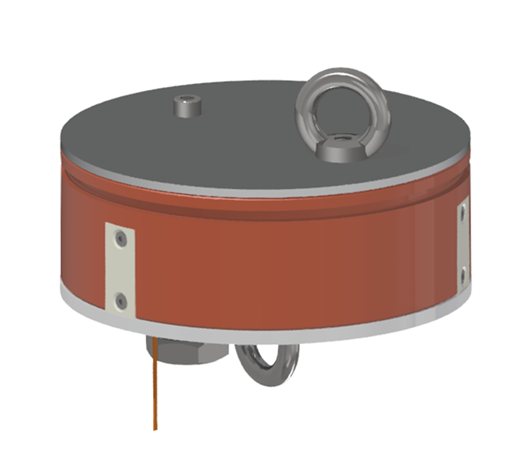
Material evolution:
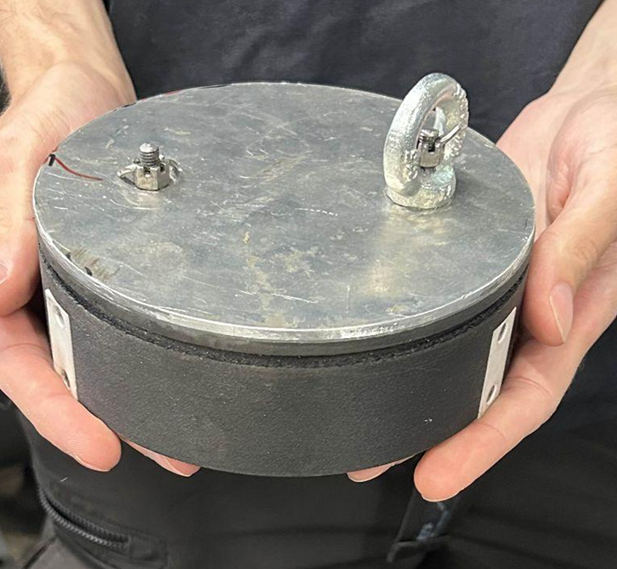
• PET-G (first iterations) – the chambers printed from PET-G withstood the gas temperatures well, but the material was too brittle to survive ground impact without damage. Each flight effectively meant a single-use chamber.
• PA12 + 15CF (currently) – switching to carbon fiber–reinforced nylon has delivered significantly improved impact resistance and thermal performance. Thanks to the elasticity of PA12 + 15CF, the chamber absorbs energy upon landing and maintains its structural integrity, allowing it to be reused multiple times in both ground tests and flight operations.
HEXA 5 flight test
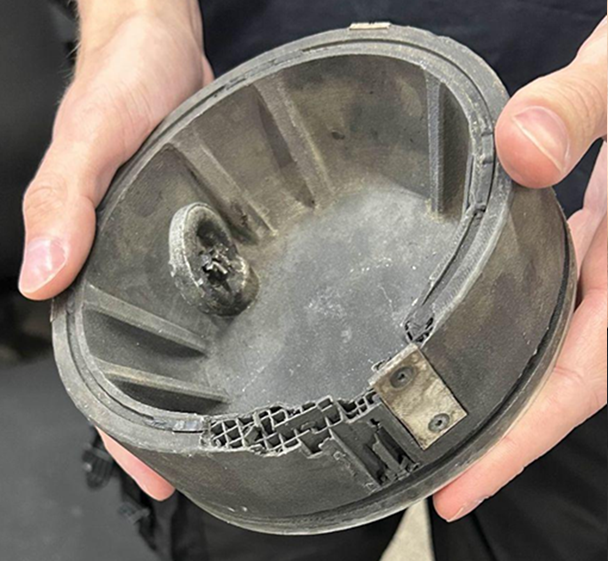
During the HEXA 5 flight, the chamber made from PA12 + 15CF performed in full accordance with the design: at an altitude of 10.5 km, the charge was ignited, the parachute was ejected, and it deployed correctly in the airflow. The crack visible in the photo occurred only after the mission had ended, when the unbraked chamber impacted the ground. During static ground tests, there was no need to print additional chambers, which saved time and reduced overall development costs.
Benefits of the new design:
• Reusability – a single chamber can withstand multiple “gas generator → ejection → landing” cycles, reducing the costs of static test campaigns.
• Greater safety margins – carbon fiber–reinforced nylon maintains structural integrity under pressure and elevated temperatures for longer, reducing the risk of uncontrolled rupture.
In summary, the pressure chamber made from PA12 + 15CF has transformed a single-use component into a durable subsystem, increasing reliability and reducing the cost of each subsequent static test.
Ground support equipmentproject and ROSA-FLEX 96A
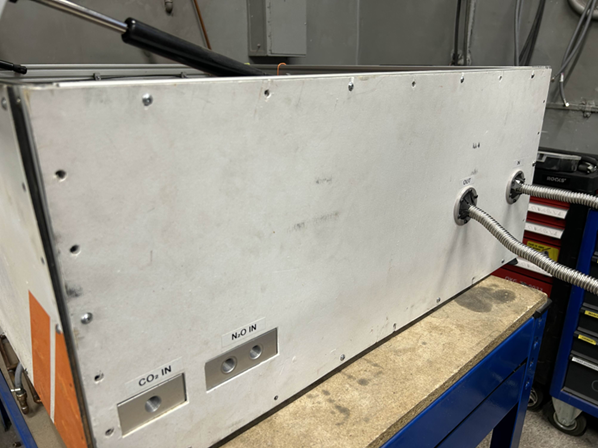
Ground Support Equipment is a ground-based station used for the remote filling of oxidizer in hybrid-propulsion rockets. The system consists of multiple valves, solenoid valves, and a main servo-actuated valve that controls the flow of nitrous oxide. Due to the high cleanliness requirements of the installation, the entire assembly has been enclosed within a sealed case. The filament ROSA-FLEX 96A, thanks to its flexibility and mechanical resistance, is ideally suited for printing enclosure seals and fueling port gaskets. Its use effectively eliminates leaks and protects critical components from dust, sand, and other contaminants.
Talented students reach for the stars
PUT Rocketlab demonstrates that ambitious rocket projects can also be developed in academic workshops in Poland when passion is combined with solid engineering work. And when this is supported by access to high-quality materials from our ROSA3D brand and rapid prototyping enabled by 3D printing, the line between a “student project” and technology ready for real-world challenges begins to blur.

ROSA PLAST SP. z o.o.
ul. Hipolitowska 102B
05-074 Hipolitów, POLAND

Email
eshop@rosa3d.pl
Our team is at your disposal on working days during the hours:
od 7:00 do 15:00
Follow us